


If you’ve ever stared at a payslip in Lagos, Abuja, or Port Harcourt and wondered, “How did they arrive at this PAYE figure?” — you’re not alone. Tax in Nigeria has long had a reputation for being confusing, especially for people whose income doesn’t arrive in the same neat amount every month: the freelancer building websites for foreign clients, the content creator earning from YouTube, AdSense, and brand deals, the remote software engineer paid in dollars, the consultant juggling three retainers.
And now, with the Nigeria Tax Act 2025 taking effect from January 2026 — bringing a brand new ₦800,000 tax-free threshold, a fresh set of tax bands, and a redesigned relief system — getting your numbers right matters more than ever. Underpay, and you risk penalties from the Nigeria Revenue Service (NRS) (formerly FIRS) or your State Internal Revenue Service. Overpay, and you've quietly handed government money you could have invested, saved, or simply kept.
This is where a method called YTD (Year-To-Date) Aggregation comes in. It's the cleanest, most accurate way to compute personal income tax in Nigeria — especially if your income wobbles from month to month. It's also the engine behind FiscalGuard, a tax computation and compliance platform built for Nigerian independent workers. Let's break it down.
First, the basics: key tax terms in plain English
Before we go further, let’s settle a few words you’ll keep meeting:
Gross Income — every naira you earn before deductions: salary, freelance fees, royalties, brand deals, side gigs, allowances.
Allowable Deductions / Work Expenses — legitimate costs of earning your income (think: data, software subscriptions, equipment for your work). The NRS recognises these for self-employed people and businesses.
Reliefs — specific items the law lets you subtract from your income before tax: Pension contributions, National Housing Fund (NHF), National Health Insurance Scheme (NHIS), life insurance premiums, and the new Rent Relief.
Taxable Income — what’s left after you subtract deductions and reliefs from gross income. This is what tax is actually calculated on.
Self-Assessment — the principle that you (not the taxman) must work out what you owe and file it. The NRS just verifies. If you get it wrong, the consequences are yours.
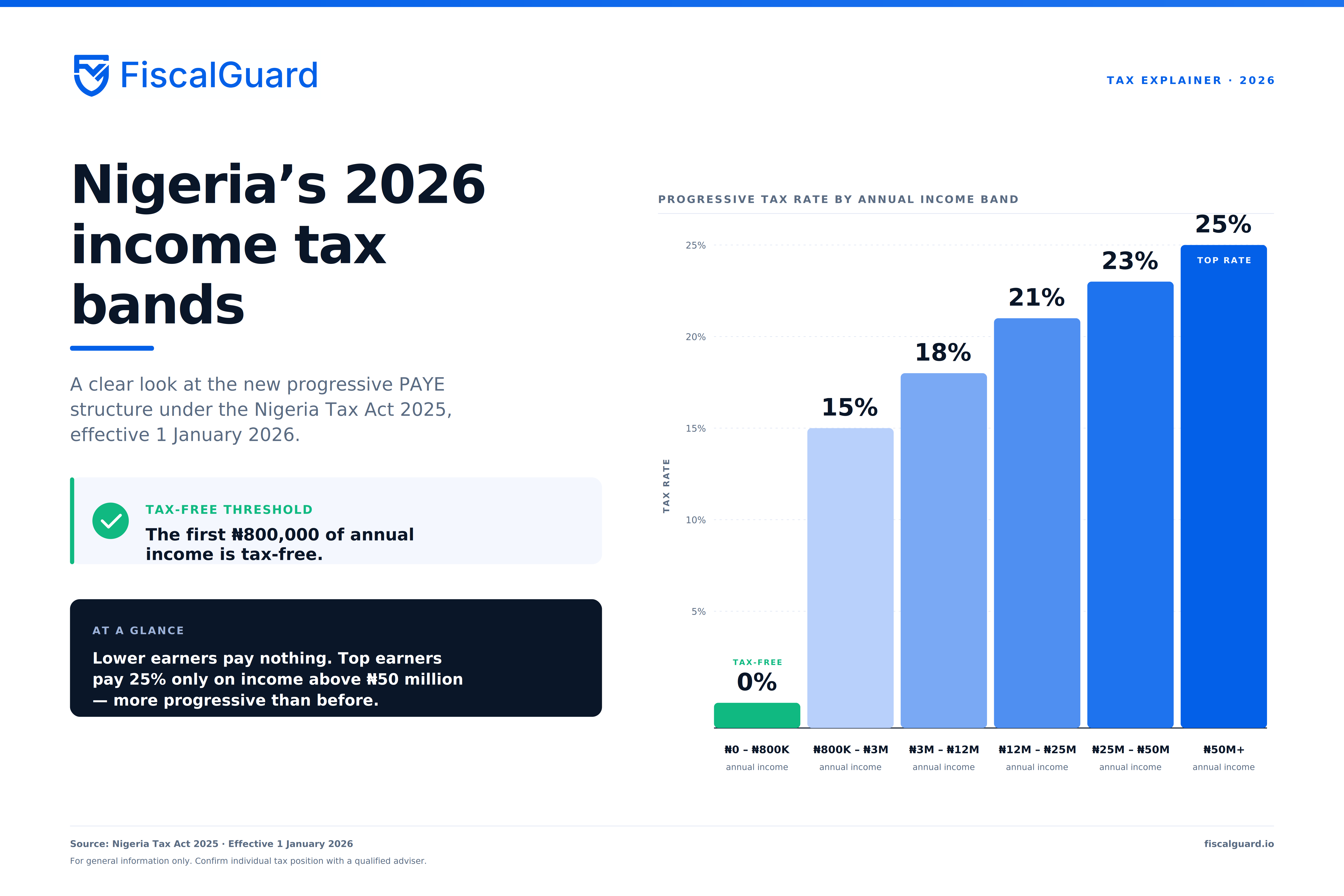
Fourth Schedule Tax Bands — the progressive tax rate ladder: 0% on the first ₦800,000, then 15%, 18%, 21%, 23%, and a top rate of 25% on annual income above ₦50 million.
Got it? Good. Now to the real question.
The problem with calculating tax month by month
The traditional way many payroll systems handle PAYE is to estimate annual income from one month's pay and tax accordingly. That works fine for someone on a flat ₦500,000 salary every month. But for a creator who earned ₦150,000 in January, ₦1.2M in February (a viral month), and ₦400,000 in March, monthly estimation falls apart fast.
You either get over-taxed during a good month or under-taxed during a quiet one — and by year-end, you're scrambling to reconcile, often with a shocking bill or an awkward refund chase.
This is exactly the gap YTD Aggregation was designed to close.
What is YTD Aggregation?
YTD Aggregation is a method that computes your tax based on everything you’ve earned and spent from January up to the current month, rather than treating each month in isolation. Instead of asking “How much tax does this single month attract?” it asks “Given the full picture so far, what should my tax position be today?”
It blends what's actually happened (gross income, deductions, reliefs, taxes already paid) with a fair forward projection (what your annual income is likely to look like at this pace), then trues up the maths.
The result: smoother, fairer tax deductions across the year, fewer surprises at filing time, and a true sense of where you stand at any moment.
The formulas, demystified
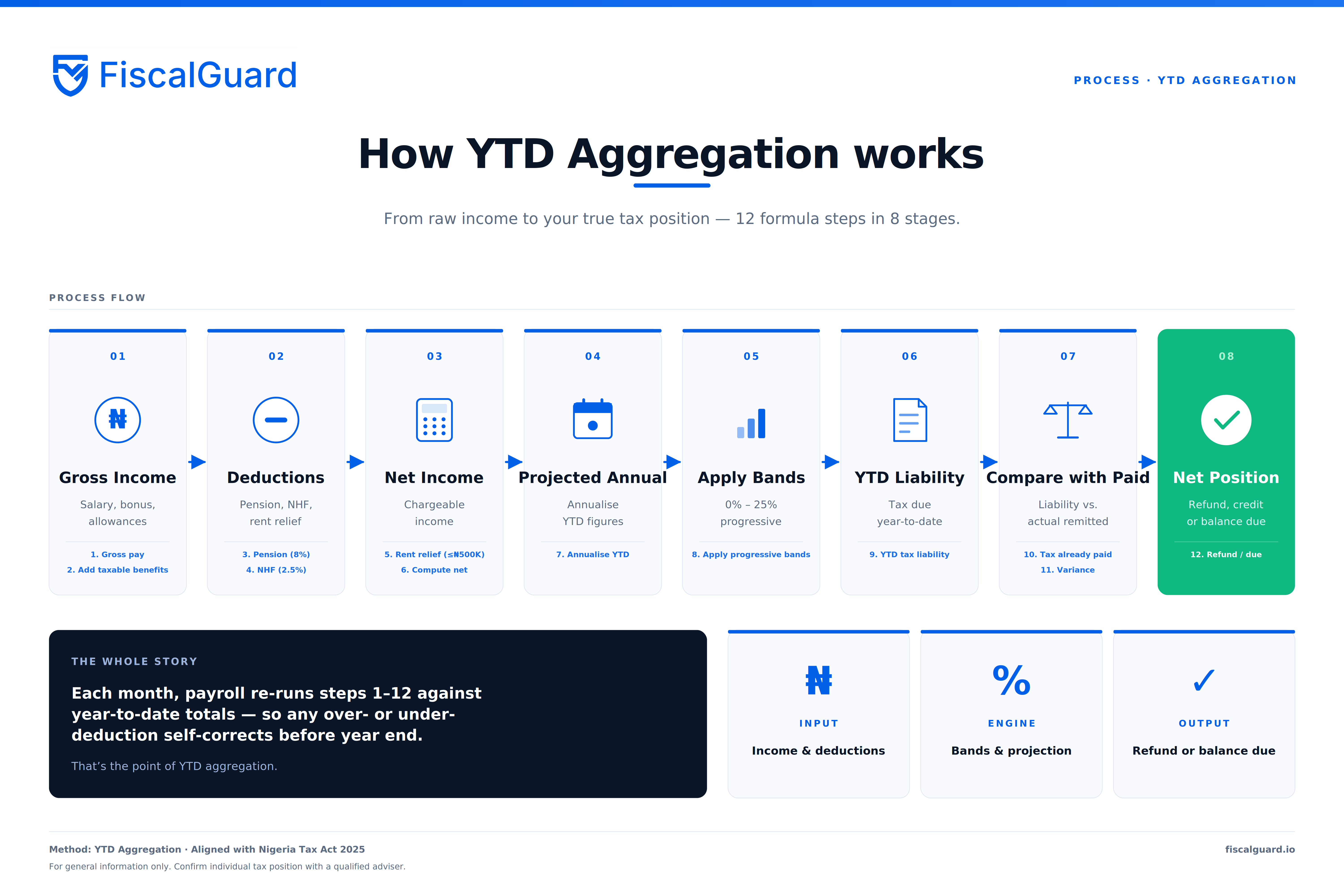
Here's the engine, step by step. Don't be intimidated — we'll walk through a real example right after.
1.  YTD Gross Income      = Sum of income from January to current month (m)
2.  YTD Work Expenses     = Sum of allowable business/work expenses, Jan → m
3.  YTD Reliefs           = Sum of Pension + NHF + NHIS + Life Insurance, Jan → m
4.  YTD Rent Relief       = (Eligible Annual Rent Relief ÷ 12) × Months Passed
5.  YTD Total Deductions  = Work Expenses + Reliefs + Rent Relief
6.  YTD Net Income        = YTD Gross Income − YTD Total Deductions
7.  Avg Monthly Net Income = YTD Net Income ÷ Months Passed
8.  Projected Annual Income = Avg Monthly Net Income × 12
9.  Projected Annual Tax  = Apply Fourth Schedule bands to Projected Annual Income
10. YTD Tax Liability     = (Projected Annual Tax ÷ 12) × Months Passed
11. Total Tax Paid YTD    = Sum of taxes already remitted, Jan → m
12. Net Tax Position      = YTD Tax Liability − Total Tax Paid YTD
That last line is the punchline. If it's positive, you still owe. If it's negative, you've overpaid.
A practical example: meet Tomi, a Lagos-based remote developer
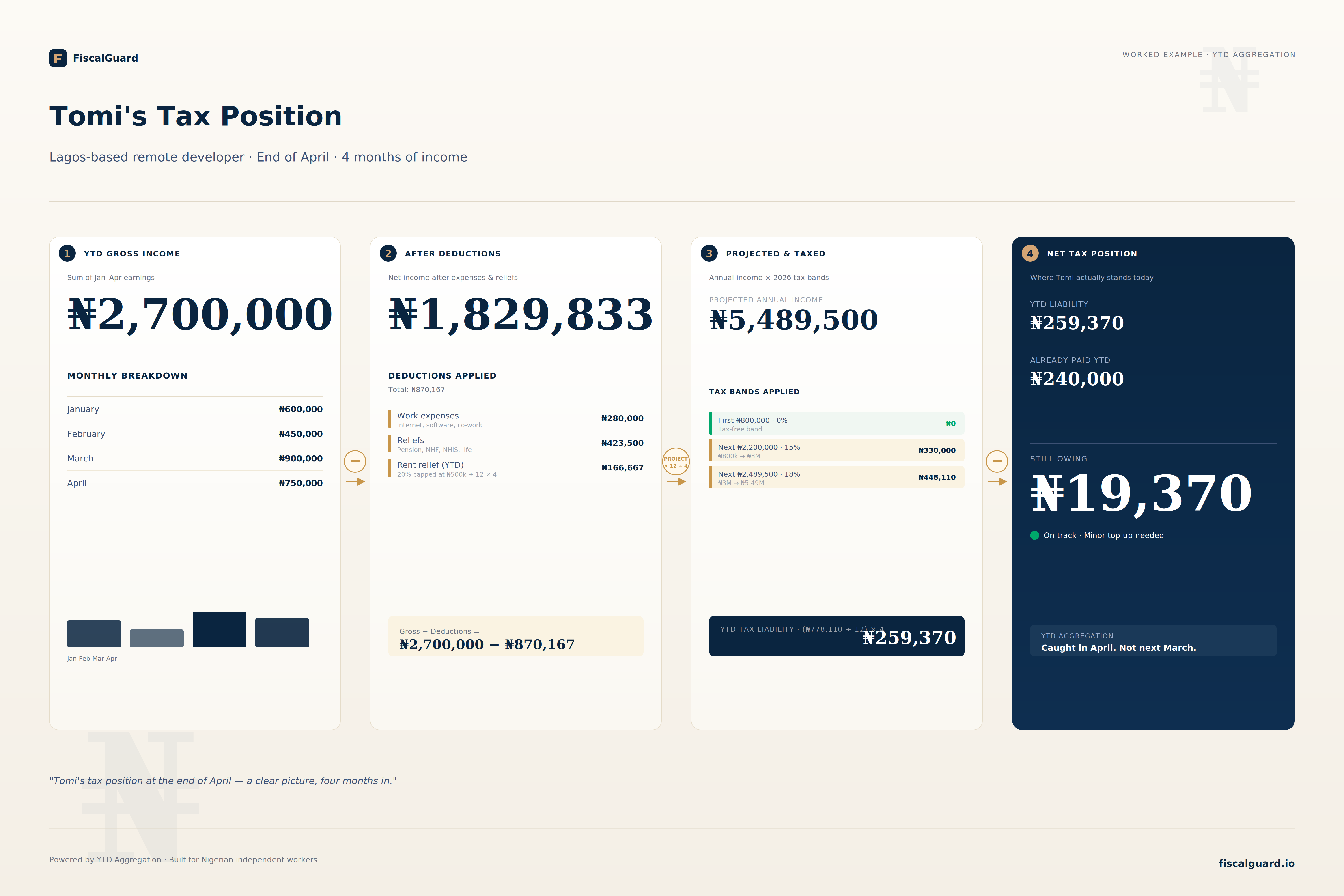
Let’s say it’s the end of April, and Tomi has been freelancing for foreign clients while also taking on local consulting gigs. Here’s her year so far:
Monthly income:
January: ₦600,000
February: ₦450,000
March: ₦900,000
April: ₦750,000
YTD Gross Income = ₦2,700,000
YTD Work Expenses (internet, software, co-working space): ₦280,000
YTD Reliefs:
Pension (8% of gross): ₦216,000
NHF (2.5% of gross): ₦67,500
NHIS contributions: ₦80,000
Life insurance premium: ₦60,000
Total: ₦423,500
YTD Rent Relief: Tomi pays ₦3M annual rent. 20% = ₦600,000, but the relief is capped at ₦500,000. So:
Per month: ₦500,000 ÷ 12 = ₦41,667
After 4 months: ₦166,667
YTD Total Deductions = ₦280,000 + ₦423,500 + ₦166,667 = ₦870,167
YTD Net Income = ₦2,700,000 − ₦870,167 = ₦1,829,833
Average Monthly Net Income = ₦1,829,833 ÷ 4 = ₦457,458
Projected Annual Income = ₦457,458 × 12 ≈ ₦5,489,500
Apply the Fourth Schedule bands:
First ₦800,000 @ 0% = ₦0
Next ₦2,200,000 (₦800k → ₦3M) @ 15% = ₦330,000
Next ₦2,489,500 (₦3M → ₦5,489,500) @ 18% = ₦448,110
Projected Annual Tax = ₦778,110
YTD Tax Liability = (₦778,110 ÷ 12) × 4 = ₦259,370
If Tomi has already remitted ₦240,000 in tax across those four months, her Net Tax Position is: ₦259,370 − ₦240,000 = ₦19,370 still owing.
She’s not behind by much, and crucially, she knows now — not next 31st of March in a panic.
Common mistakes Nigerians make when computing tax
A few patterns we see again and again:
Using gross income instead of taxable income as the base for tax. You’re entitled to your reliefs and deductions — claim them. The NRS isn’t going to remind you.
Forgetting that the CRA is gone. Under the new Nigeria Tax Act, the old Consolidated Relief Allowance has been replaced by the Rent Relief and the higher ₦800,000 zero-tax band. Older online calculators that still apply CRA will give you wrong numbers in 2026.
Mixing up rent paid with rent relief. The relief is 20% of your annual rent, capped at ₦500,000 — not the full rent figure.
Not keeping receipts. If the tax authority queries you, “trust me, I paid” won’t fly. Keep every relevant invoice, payment record, and bank statement.
Treating one good month as the new normal. Freelancers especially over-tax themselves when income spikes — YTD aggregation is the antidote.
Skipping filing because PAYE was deducted. If you have side income — affiliate revenue, foreign clients, royalties — your employer’s PAYE doesn’t cover it. You still need to file.

Why compliance matters now more than ever
The 2026 tax reforms didn’t just reshape rates — they brought stiffer penalties, mandatory Tax Identification Numbers (TINs) linked to your NIN, and a more digitised compliance regime through the NRS and platforms like TaxPro Max. Your State Internal Revenue Service (LIRS in Lagos, OGIRS in Ogun, FCT-IRS in Abuja, etc.) handles personal income tax for residents and individuals; the NRS handles federal-level taxes including company income tax and VAT.
Bottom line: the system is getting smarter and more connected. Quiet non-compliance is no longer a comfortable strategy.
Why FiscalGuard uses the YTD Aggregation method
We chose YTD Aggregation as the engine behind FiscalGuard for one simple reason: it tells the truth in real time.
Other methods either freeze you into rigid monthly assumptions or force you to wait until year-end before you discover where you really stand. YTD Aggregation, by contrast:
Adapts to irregular income — perfect for creators, freelancers, contractors, remote workers, independent workers, and anyone with variable earnings.
Reflects reliefs as they accrue, including rent relief spread evenly across the year so you’re not over-taxed early on.
Projects annual liability fairly, using your actual pace rather than a single month’s snapshot.
Reconciles continuously, so you always know whether you’re ahead, behind, or square with the NRS.
Makes year-end filing painless — your YTD figures are your annual return, ready to go.
For Nigerians who want to stay compliant without making tax their second job, that clarity is everything.
Final word: small habits, big difference
Tax in Nigeria doesn’t have to be a yearly anxiety. A few habits will carry you a long way:
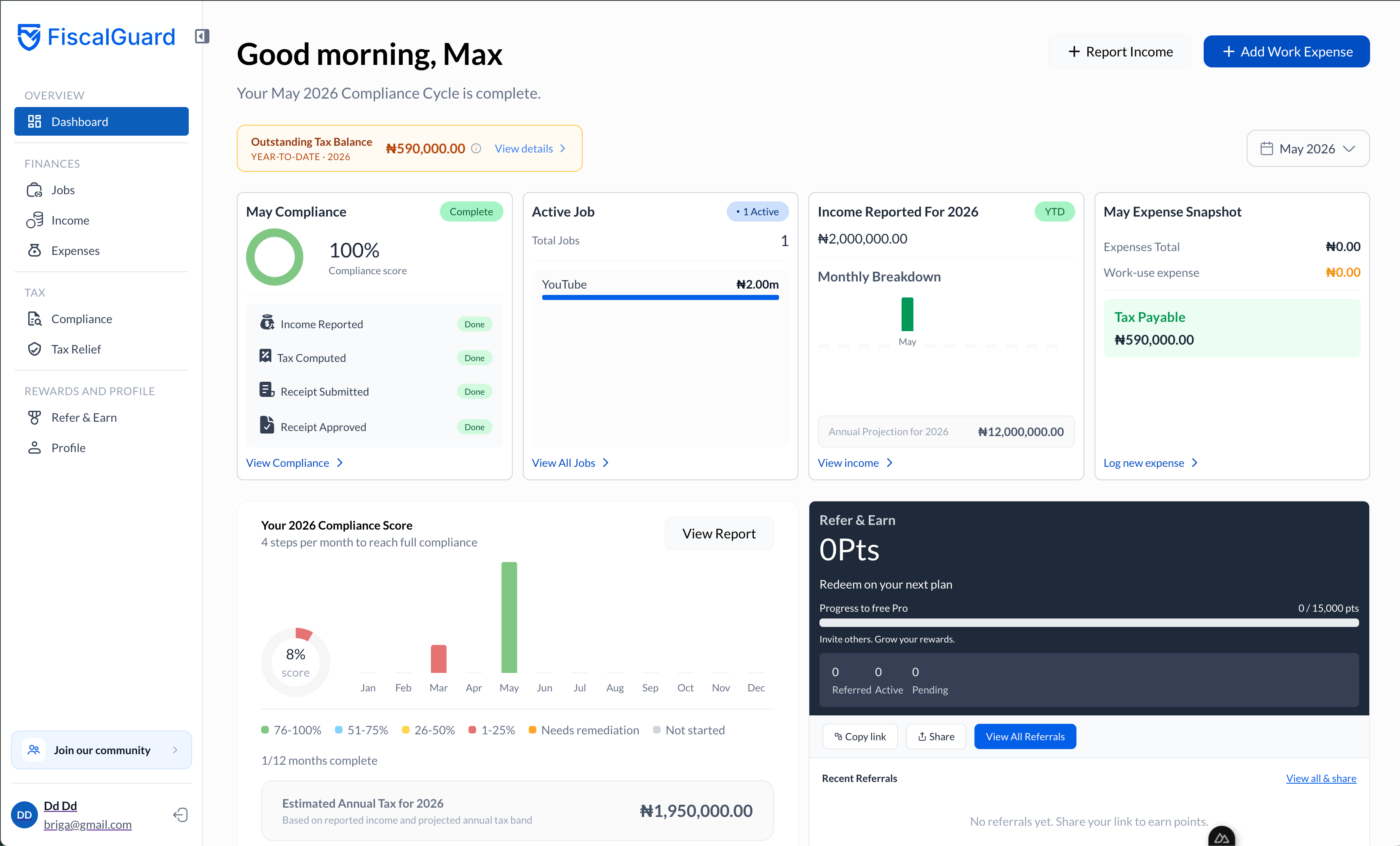
Track your income monthly — don’t wait until March of the following year.
Claim every relief you’re entitled to — pension, NHF, NHIS, life insurance, rent relief. They’re yours.
Keep clean records — digital receipts, an income log, a deductions folder. FiscalGuard helps you achieve this.
Use a YTD-based tool like FiscalGuard so you always see your true position — built specifically for Nigerian freelancers, creators, and independent workers.
File your annual return by March 31 of the following year, even if PAYE has been deducted at source or you are self-assessing.
The tax system is changing. The smart move isn’t to fear it — it’s to understand it, work the maths in your favour, and keep the receipts. Your future self, holding a clean compliance record and a healthier bank balance, will thank you.
